That is the question. Well. Unlike Hamlet, it’s not exactly a question of life
or death. It’s more a question of could this be any fun? At all? I decided to
join the Hackathon at the Databricks Data and AI Summit, 2026. The title was
“Databricks Apps & Agents for Good Hackathon 2026”. Beyond that, I didn’t know
what I was getting into.
The first challenge was getting signed up. The Hackathon fills up quickly! I
know because last year I tried (to have fun) and I didn’t sign up in time and
wasn’t able to join (boo). Once signed up, there was still an application form
and the entrant’s “statement of motivation” for participating in the Hackathon.
I believe I wrote: “It sounds like fun to me.” According to the rules, not
everyone gets invited to join. Lucky me!
Once accepted to the Hackathon, and a few days before it began, some
instructions arrived including 1) use the FREE Databricks edition with a
personal email and 2) how to apply for some OpenAI credits (the Agents part).
Both things would be needed for the project.
Upon arrival on Hackathon Monday, we attended a presentation by Virtue
Foundation (VF). Their website says: “Delivering care and using data science for
good in global health”. The speaker outlined the many challenges that health
care deserts present and how VF is using Databricks, data, analytics, machine
learning and AI to bridge the gaps.
We were given our assignment! One of four topics. We (me and two complete
strangers made up a Hackathon team) chose the topic: “Where are the real highest
risk gaps in care?” The teams were made up of 2-4 people. If you didn’t arrive
with your own team members, you got teamed up with strangers. (Evidently this is
part of the fun) At breakfast, right before the start of the Hackathon, I was
invited to join a team, so the first potential problem was solved. Sidebar:
Sometimes teaming up with strangers can result in unexpected happenings. Just
saying. On the other hand, our team was made up of two data scientists and one
data engineer, and it was fantastic! (phew!) The rest of the Hackathon rules
were: use the Free Edition of Databricks, use Agents, use the VF dataset
provided (via the Databricks Marketplace), create an app that sources from
LakeBase (GA as of Feb 2026) and showcase the chosen topic. Go do your thing.
The VF dataset included details of health care facilities in India, population
health metrics and risks, and together with India Post PIN codes (for maps and
such), we got started. The goal of our topic was to identify the “highest risk
gaps”. There was some discussion about what constituted a “risk”, and therefore,
what exactly, should be showcased. We decided to focus on patient accessibility
as related to distance.
Uploading the source data into Databricks’ Unity Catalog Delta tables was super
easy. Creating the pipelines was super easy too, especially when we let Genie do
it. (Genie is Databricks’ AI powered conversational interface.) The data
scientists, plus the Agents, got to work coding and calculating facility
accessibility using Haversine distance formula and predicting scores using ML
linear regression. The model was logged to MLFlow and registered to Unity
Catalog. The scores ranged from low to critical, with critical indicating very
limited access to health care facilities. These values were written to Delta
tables and then continuously synced to LakeBase tables for sub-10 ms query
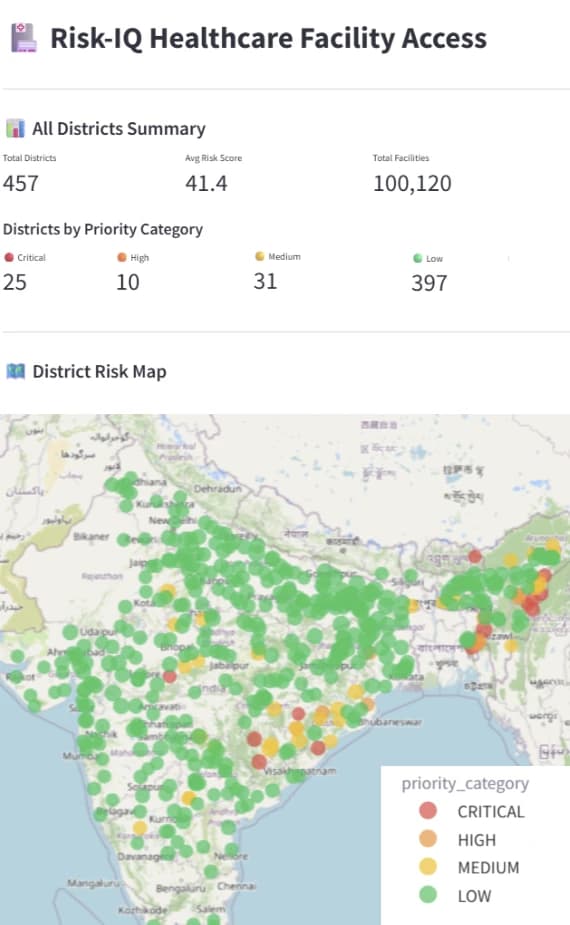
latency, which in turn, supplied the App. The Agents helped us code both the App
and a Dashboard. The App included a map showing the distribution of health care
facilities with the total counts of each score. Voila! The project was
completed.
Well almost. There was the usual git repository check in. The Devpost submission
(this was new to me), and the three minute presentation to the Databricks team.
We didn’t win, but we had fun trying. So yes, I do recommend a Hackathon.
Especially a Databricks one!